


Back-office agentic workflows built on Claude
NOV. 4, 2026
6 Min Read
Back-office processes with clear rules and messy inputs return value from agentic workflows faster than any other part of the enterprise.
Invoice matching, vendor onboarding and expense review all follow written policy, yet the inputs arrive as PDFs, emails and spreadsheets in a dozen formats. That mix has always been too irregular for scripted automation and too repetitive for skilled staff. An agent that reads the input, applies the policy and hands exceptions to a person fits it closely.
The risk is building agents without a business case. Gartner predicts over 40% of agentic AI projects will be canceled by the end of 2027 because of rising costs, unclear value or weak risk controls. Back-office work avoids all three, because the cost of today's process is known, the policy already exists and approval steps are already part of the job.
Key Takeaways
- 1. Back-office processes with written rules and varied inputs return value from agentic workflows faster than other parts of the business.
- 2. Agentic workflows handle new document layouts and route exceptions to people, while RPA stays the right tool for fixed, high-speed screen tasks.
- 3. Human approval belongs before money moves, before master data changes and before anything leaves the company, with every other step logged.
What agentic workflows do in back-office operations
An agentic workflow is a process where an AI model reads inputs, decides the next step and calls tools to complete it, within limits you set. For back-office teams, that means an agent can extract data from a document, check it against policy, update a system of record and route anything unusual to a person.
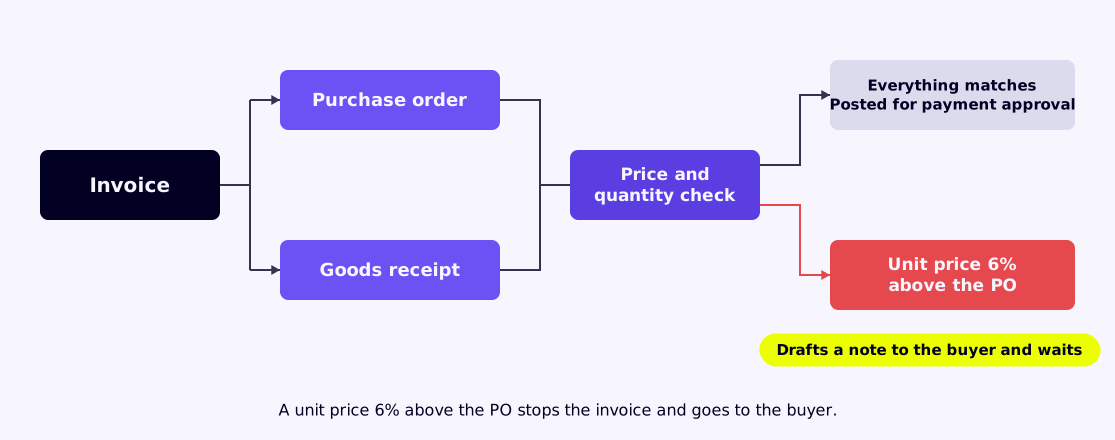
Take accounts payable as an example. An agent built on Claude reads an incoming invoice, finds the matching purchase order and goods receipt, and checks price and quantity against tolerance. When everything matches, it posts the invoice for payment approval. When the unit price is 6% above the PO, it drafts a note to the buyer with the two figures side by side and waits.
The difference from a chatbot is that the agent finishes work instead of answering questions about it. That's also why design matters more than model choice. The value comes from the tools it can call, the rules it follows and the points where it stops.
Which back-office processes are the best fit for agentic AI
The best first candidates are high-volume processes with written rules, varied inputs and a measurable cost per transaction. Accounts payable, vendor onboarding, intercompany reconciliation and claims intake fit that profile. Processes that rely on judgment with no written policy, such as credit approvals for new markets, should wait.
"The difference from a chatbot is that the agent finishes work instead of answering questions about it."
A quick screen helps you rank candidates.
- Volume is high enough that a small time saving per item adds up
- A written policy already defines the correct outcome
- Inputs vary in format, which has defeated scripted automation
- Exceptions are a minority of cases and there's a named team to route them to
- Cycle time or error rate is already tracked, so the result is provable
A shared services center processing 40,000 supplier invoices a month will usually clear this screen for accounts payable before anything else. The baseline is in the ERP, the policy is in the controls manual and the exception queue already has an owner.
Agentic workflow versus RPA for finance operations
The main difference between an agentic workflow and RPA is how each handles variation. RPA follows a recorded script and breaks when a screen, field or format changes. An agentic workflow reads the input, reasons about it against policy and chooses the next step, so a new invoice layout doesn't stop it.
That shows up in maintenance. A bot that keys invoices into the ERP from one supplier template needs rework every time a supplier changes its PDF. An agent doesn't care which layout arrives, so there's no code change. RPA still wins on fixed, high-speed screen tasks with no variation, and many finance teams keep it there.
| Factor | RPA | Agentic workflow |
|---|---|---|
| Input handling | Works when every input arrives in the same layout | Reads documents, emails and tables in formats it hasn't seen before |
| Decision logic | Follows fixed if-then steps recorded in the script | Applies written policy and explains which rule it used |
| Exceptions | Stops and fails the run when anything is unexpected | Routes the case to a named person with a summary and a suggested action |
| Maintenance | Needs rework whenever a screen or template changes | Needs policy updates when rules change, with no rework for new layouts |
| Best fit | Fixed, high-speed tasks on stable systems | Rule-based work with varied inputs and a steady share of exceptions |
Read the table as a split of work rather than a replacement. Keep RPA on the stable, high-volume screen tasks it already runs well, and move the exception-heavy steps, such as invoice matching and supplier queries, to an agentic workflow where varied inputs are the norm. Many finance teams end up running both, with the agent handing clean, structured work to the bots they already have.
How to build agentic workflows that finance teams trust
Build agentic workflows that finance teams trust by starting from the controls they already use. Map the current process, write down each policy rule the agent will apply, limit its tool access to what the step needs and log every decision. Trust comes from seeing the agent follow the same rules a person would.
Lumenalta®designs these workflows on Claude with teams of senior specialists and agents, and governance built into the design from day one. For a vendor onboarding agent, that means read access to the vendor master, no ability to change bank details on its own and a log entry for every check it runs against sanctions lists and tax records.
Context is the other half of trust. Agents need the right context to make business-correct decisions. For a finance agent, that context is the approved vendor list, the tolerance table and the chart of accounts, read from governed sources rather than pasted into a prompt.
Test against last quarter's actual transactions before going live. If the agent's decisions match what your team did on 95 of 100 invoices and the other five are reasonable exceptions, you have something finance will sign off on.
Where human approval belongs in an agentic workflow
Human approval belongs where the business risk sits, never at every step. Place it before money moves, before master data changes and before anything leaves the company. Everywhere else, let the agent work and log what it did, so people review outcomes instead of rubber-stamping each action.
An expense review agent can approve a $40 taxi receipt that matches policy without anyone seeing it. It should route a $4,000 client dinner to a manager, and it should never change an employee's bank account. Approval placed this way keeps cycle time low while protecting the decisions an auditor would ask about.
What to measure in the first 90 days of production
Measure four things in the first 90 days. Track cycle time per transaction, the share handled without human touch, the exception rate and the error rate found in review. Compare each against the baseline you captured before launch, so the business case rests on your numbers rather than a vendor's.
"Human approval belongs where the business risk sits, never at every step."
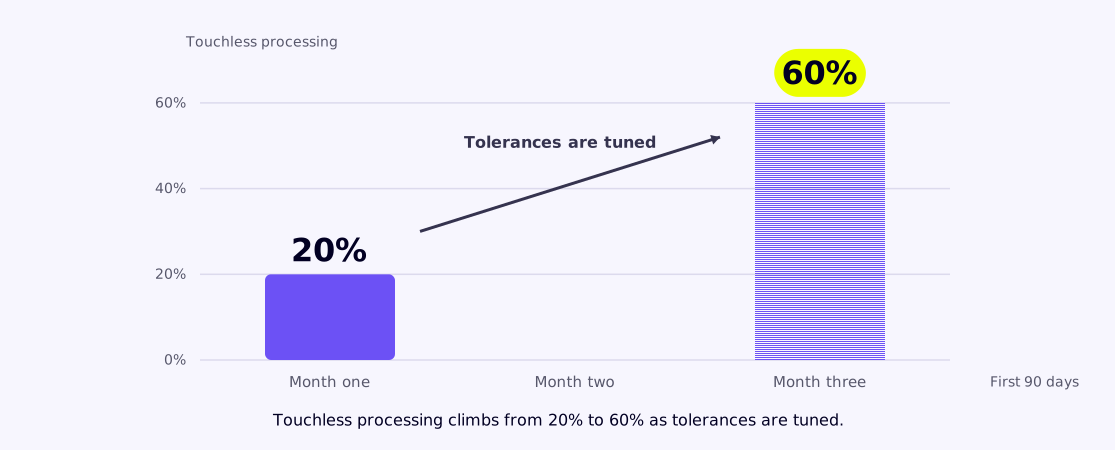
A team running an invoice agent might see touchless processing climb from 20% in month one to 60% by month three as tolerances are tuned. That trend matters more than any single week. If the error rate rises with it, slow down and fix the rules before widening scope.
Report cost per invoice to the CFO in the same format finance already uses. It's the language the budget owner already recognizes.
Why the back office is the right starting point for agents
The back office is the right starting point because its rules give an agent a clear target and its messy inputs give it work no script could handle. That combination produces measurable savings quickly and builds the controls and confidence you'll need for agentic work in riskier parts of the business.
Disciplined execution is what separates a durable workflow from a pilot. Teams that write down the policy, limit tool access, place approvals where risk sits and measure against a baseline end up with agents that finance and audit both accept. Teams that skip those steps end up with a demo.
Lumenalta® builds back-office workflows on Claude as an Anthropic Select Partner, with the human approval steps designed in from the first sprint. The aim is a process your controllers would recognize as their own, only faster.
Table of contents
- What agentic workflows do in back-office operations
- Which back-office processes are the best fit for agentic AI
- Agentic workflow versus RPA for finance operations
- How to build agentic workflows that finance teams trust
- Where human approval belongs in an agentic workflow
- What to measure in the first 90 days of production
- Why the back office is the right starting point for agents
See how agentic workflow design improves AI accuracy and controls spend.