


Controlling generative AI output in regulated enterprises
NOV. 13, 2026
6 Min Read
Regulated enterprises can approve generative AI faster when they govern its output as closely as the model that produces it.
Most model risk frameworks in banking and insurance were built for predictive models. They validate training data, test accuracy on a holdout set and monitor drift. A generative system adds risks those frameworks never had to consider. A prompt can be manipulated, a retrieval step can surface a document the user shouldn't see and the output is free text that can state anything, including a rate or a coverage term that doesn't exist.
Confidence hasn't caught up with deployment. Only 23% of IT leaders said they were very confident in their organization's ability to manage security and governance when deploying generative AI tools, in a Gartner survey of 360 IT leaders. Extending the controls you already trust to cover prompts, retrieval and output closes that gap, and it shortens review cycles instead of adding to them.
Key Takeaways
- 1. Generative AI governance has to cover prompts, retrieval and output, because predictive model validation says little about what a deployed system will say.
- 2. Regulated firms move faster when they map each generative AI risk to an existing control family instead of building a new governance structure.
- 3. Tiering use cases by risk and pre-approving the controls for each tier turns most approvals into a check that the controls are in place.
Why controlling the output of generative AI systems is important
Controlling the output of generative AI systems is important because the output is what customers, regulators and employees act on. A wrong figure in a loan summary or a made-up policy term in a claims letter creates the same liability as if a person wrote it. Output control is where model risk turns into conduct risk.
Consider a wealth management firm using a model to draft client portfolio reviews. If the model invents a performance figure or recommends a product the client isn't eligible for, the firm owns that statement. The model's training quality doesn't change the regulatory exposure. What matters is if anything checked the sentence before it went out.
Output control also changes what you can prove. A supervisor asking how the firm stops a model from overstating returns wants to see a check that ran on each review and a record of what it caught. That record is far easier to defend than a model card describing how carefully the model was trained.
Where predictive model governance falls short for generative AI
Predictive model governance falls short because it assumes a fixed input schema, a numeric output and a stable test set. Generative systems take open-ended prompts, pull in documents at runtime and return free text. Accuracy on a validation set says little about what the system will say to the next user.
A credit scoring model gets validated once a year against a defined population. A customer service assistant built on a large language model faces new questions every hour, and its answers depend on which policy documents retrieval returned. Validating the base model alone misses both moving parts.
The gap shows up in incident data. Reported AI incidents reached a record 362 in 2025, according to the Stanford AI Index. Few of those trace back to a badly trained model. Many trace back to what a deployed system said or did once it met real users and real data.
What belongs in a generative AI governance framework
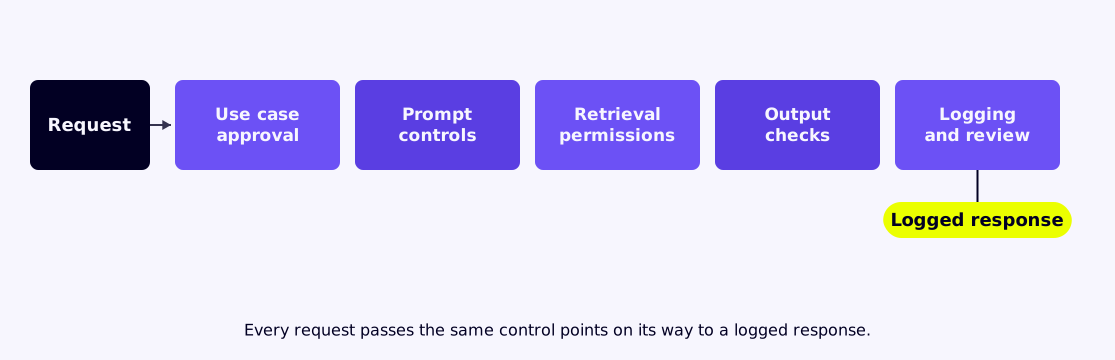
A generative AI governance framework should cover the full path from request to response. That means controls on who can use the system and for what purpose, on what the prompt can contain, on which data retrieval can reach, on what the output can say and on how every exchange is logged for review.
"Output control is where model risk turns into conduct risk."
Most regulated firms find it easiest to organize the framework by control point.
- Use case approval that records purpose, risk tier and an accountable owner
- Prompt controls that filter injection attempts and restricted topics
- Retrieval permissions that match each user's existing data entitlements
- Output checks for facts, prohibited statements and required disclosures
- Logging and review that keep every exchange available to audit
The framework doesn't need new committees. Each control point maps to a function you already have, from model risk and data governance to compliance and internal audit.
How prompt and retrieval controls shape what a model can say
Prompt and retrieval controls shape output by limiting what the model sees before it writes. A model can't leak a document it never retrieved, and it can't follow an instruction a prompt filter removed. These upstream controls stop most output problems before an output check ever runs.
Enterprise AI is limited more by context than by intelligence. For a regulated firm, context means retrieval that respects entitlements. An insurance adjuster's assistant should only retrieve claims and policy documents the adjuster can already open in the core system. When retrieval inherits those permissions, the model's answer can't reach beyond the user's access. Prompt filters do the same job on the way in, stripping instructions that try to override the system's rules or pull in restricted topics such as pending litigation.
How to check generative AI output before it reaches a customer
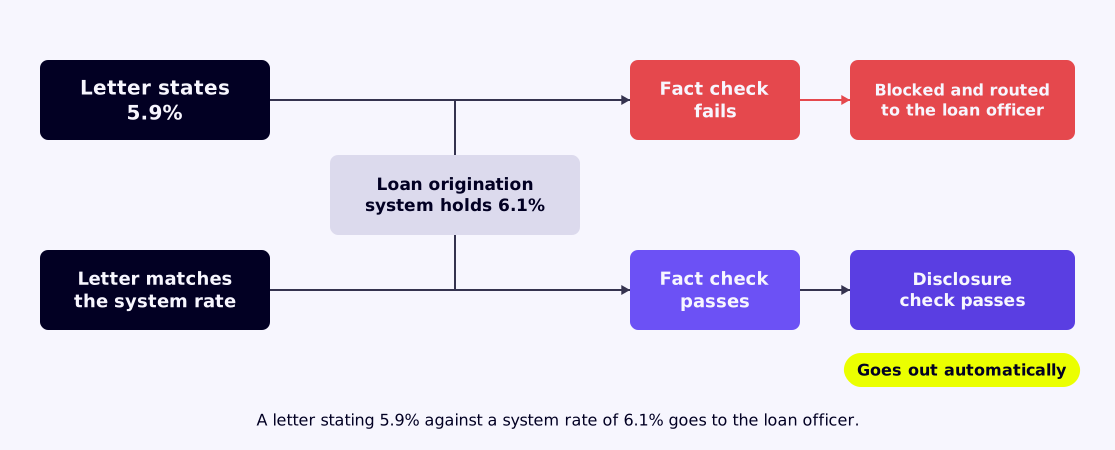
Check output in layers before it reaches a customer. Run automated checks for prohibited statements, required disclosures and facts that can be verified against source systems. Send anything that fails or falls in a high-risk tier to a person. Store the original output, the checks it passed and the reviewer's decision in one record.
A bank drafting mortgage pre-approval letters with a model might verify every rate and amount against the loan origination system before release. If the letter states 5.9% and the system holds 6.1%, the letter is blocked and routed to the loan officer. A disclosure check confirms the required wording is present. Only letters that pass both go out automatically.
Fact checks only work when the system of record is itself trusted. If the loan origination system holds two rates for the same application, the check can't tell which one is right, so output control depends on the data governance underneath it.
The tradeoff is latency and cost. Every check adds time, so match the depth of checking to the risk tier of the use case rather than applying the heaviest checks everywhere.
Who should own generative AI governance in a regulated company
Ownership should sit with an accountable executive for each use case, supported by a central team that sets standards. The business owner answers for the outcome. Model risk, data governance, security and compliance each own their control point. A single central owner for everything tends to become a bottleneck within months.
"A model can't leak a document it never retrieved, and it can't follow an instruction a prompt filter removed."
An insurer might name the head of claims as owner of a claims summary assistant, with model risk validating it, data governance approving retrieval sources and compliance signing off on letter templates. Each team works on the part it already knows. The central AI governance office tracks the inventory and the risk tier, and steps in only when a use case crosses a threshold. That split keeps decisions close to the people who understand the process, while giving the board one view of every generative AI system in use.
How banks and insurers can extend existing controls
Banks and insurers can extend existing controls by mapping each generative AI risk to the control family that already handles something similar. Access reviews cover retrieval permissions. Communications surveillance covers output. Model validation covers evaluation. Change management covers prompt and model updates. Very little has to be invented.
Lumenalta®works with regulated firms to extend those controls into the data and AI platform itself, with decision traceability and compliance controls embedded in delivery. That keeps generative AI inside the same evidence trail auditors already know.
| Generative AI risk | Existing control family to extend |
|---|---|
| A user retrieves data outside their role | Entitlement reviews applied to the retrieval layer as well as source systems |
| A prompt injection changes model behavior | Input validation and security testing, now run against prompts |
| Output states a wrong rate or term | Fact checks against systems of record, as in existing document controls |
| Required disclosures go missing | Communications compliance review, automated for model-drafted text |
| A prompt or model update changes answers | Change management with regression tests before release |
How to approve generative AI use cases faster
Approve generative AI use cases faster by tiering them by risk and pre-approving the controls for each tier. A low-risk internal search tool shouldn't wait in the same queue as a customer-facing advice assistant. When the control set for a tier is already approved, review becomes a check that the controls are in place.
A bank might define three tiers. Internal productivity tools need standard access controls and logging. Employee-facing decision support adds output checks and human review samples. Customer-facing use adds pre-release fact checks and compliance sign-off. A new internal tool that fits tier one can launch in weeks because nobody needs to debate its controls.
Tiering also gives risk teams a clearer view. They spend their time on the few high-risk use cases instead of spreading it thin across dozens of low-risk ones.
Why governed output is what lets generative AI scale
Governed output lets generative AI scale because it gives risk and compliance teams evidence instead of assurances. When every response is checked, logged and traceable to its sources, approving the next use case becomes routine. Without that evidence, each new use case restarts the same debate.
The firms that move fastest rarely have the most advanced models. They have tiers, owners and controls that were settled early and reused for every new use case. Each approval adds evidence, and each audit finds the same trail, so confidence grows with the portfolio instead of shrinking under it.
That's the work Lumenalta® does with regulated enterprises, extending existing controls to generative AI so review cycles shrink as the portfolio grows. It's careful work, and it's what turns a single approved pilot into a program.
Table of contents
- Why controlling the output of generative AI systems is important
- Where predictive model governance falls short for generative AI
- What belongs in a generative AI governance framework
- How prompt and retrieval controls shape what a model can say
- How to check generative AI output before it reaches a customer
- Who should own generative AI governance in a regulated company
- How banks and insurers can extend existing controls
- How to approve generative AI use cases faster
- Why governed output is what lets generative AI scale
See how generative AI governance improves AI accuracy and controls spend.