


Governance controls autonomous AI agents need in regulated firms
NOV. 16, 2026
6 Min Read
Autonomous AI agents stay safe in a regulated firm only when governance controls what they may decide, and most programs still stop at what they may read.
Over 40% of agentic AI projects will be canceled by the end of 2027, Gartner predicts, with inadequate risk controls listed beside cost and unclear value. That forecast should worry anyone running agents in banking, insurance or healthcare. An agent that can approve a refund or close a case is making decisions your regulators expect a person to own. Data access policies don't answer that. They describe what the agent can see, while the risk sits in what it does next.
The firms getting agents into production write the decision rules first. They set which actions an agent may take alone, which ones need a person, and how every choice is recorded. Autonomy then grows on evidence, one action class at a time. It doesn't arrive all at once in a pilot nobody can audit.
Key Takeaways
- 1. Autonomous AI agents in regulated firms need controls on what they may decide, set per action, on top of the controls on what they may read.
- 2. Written decision boundaries, named escalation owners and a replayable audit trail turn agent autonomy into a policy an examiner can check.
- 3. Agents should earn wider autonomy one action class at a time, on a record of accuracy, overrides and clean audits.
What autonomous AI agents decide inside a regulated firm
An autonomous AI agent takes a goal, plans the steps and acts through tools without a person approving each move. Inside a regulated firm, those actions are decisions with legal weight. They include approving a payment exception, flagging a customer for review and editing a record that feeds a regulatory report.
Consider a claims operation at a midsize insurer. The claims agent reads the policy, checks the adjuster notes and pulls the payment history. Then it proposes a settlement and, if allowed, issues it. The reading is low risk. The settlement is a financial commitment the firm has to defend to the customer, the auditor and the state regulator.
That split is where governance has to start. Most firms already know how to govern a dashboard or a report. Agents add a new category of work, because the output is an action that changes something. You can't review it after the fact the way you'd review a chart. Once a payment leaves, the control that mattered was the one before it.
Why read access controls miss the risk agents carry
Read access controls decide which tables, documents and systems an agent can see. They're necessary, and they're also incomplete. Two agents with identical data permissions can carry very different risk. One only summarizes accounts, while the other can move money between them. Permissions on data say nothing about permissions on action.
A bank's service agent shows the gap. It needs read access to balances and transaction history to answer a customer. Give the same agent a write tool for fee reversals and the read policy stays the same while its authority grows. A review of data entitlements alone will approve it without seeing the new power. An agent is only as good as the context it has. Regulated firms need that context to cover tool permissions as well as governed business definitions, so the agent knows what a fee reversal means and when it may issue one.
How decision boundaries set the limits of agent autonomy
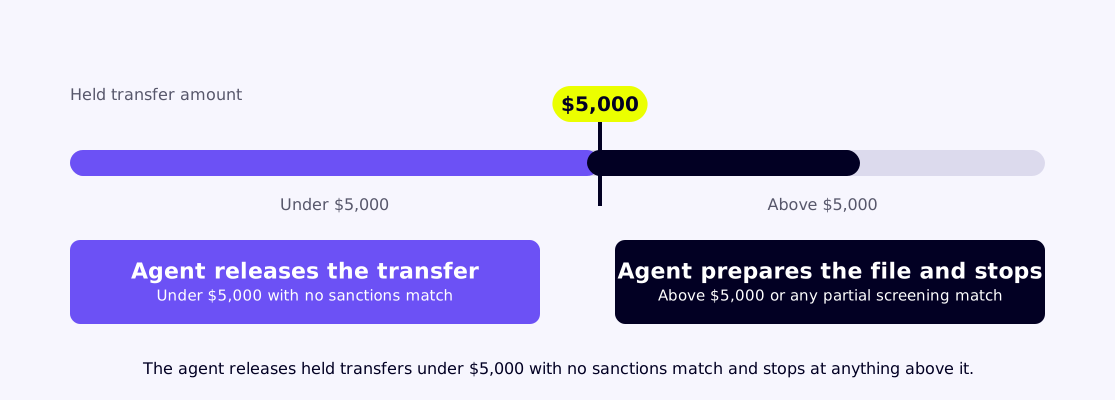
A decision boundary is a written rule stating which actions an agent may take alone, under what limits and with which evidence. It turns autonomy from a model property into a policy you can audit. Good boundaries name the action, the threshold, the checks the agent runs first and the condition that hands the case to a person.
"A boundary that lives only in the system prompt is a suggestion."
A payments team might let an agent release held transfers under $5,000 when sanctions screening returns no match. Above $5,000, or with any partial screening match, the agent prepares the file and stops. The rule fits on one page, and a risk officer can read it without knowing how the model works.
Boundaries belong in configuration, enforced by the platform the agent runs on. A boundary that lives only in the system prompt is a suggestion. Models follow instructions most of the time, and regulated work can't be governed on most of the time.
The tradeoff is the speed of change. Every boundary edit becomes a controlled release with an owner and an approval record. That's slower than editing a prompt. It's also the discipline your model risk team already applies to credit models.
Matching agent autonomy levels to the risk of each action
Autonomy should be set per action, scaled to how reversible the action is and how much harm a wrong call would cause. One agent can work at several levels at once. It can draft freely, recommend with review and execute alone only where errors are cheap to reverse and easy to detect.
A wealth management firm running a client onboarding agent shows how this plays out. The agent extracts data from identity documents on its own because a person checks the file later. It recommends a risk rating for review, since the rating drives suitability rules. It never opens an account without a named approver, because that action creates obligations the firm can't quietly undo.
The scale below gives you a working starting point. Most first production agents belong at the second and third levels.
| Autonomy level | What the agent does | Where it fits in a regulated firm |
|---|---|---|
| 1. Assist | The agent drafts summaries that a person edits and sends. | Customer letters, policy research and internal notes carry little direct risk. |
| 2. Recommend | The agent proposes an action with its evidence, and a person approves each one. | Risk ratings, credit memos and large claim settlements start here. |
| 3. Act within limits | The agent executes inside written thresholds and escalates everything else. | Low-value refunds, held transfers and routine data corrections suit this level. |
| 4. Act and report | The agent runs a full action class and reports results for sampled review. | Large batches of reversible tasks qualify once monitoring has a clean record. |
| 5. Full autonomy | The agent sets its own goals and acts without review. | Almost no regulated decision is ready for this level today. |
Escalation paths that put a named person on every exception
An escalation path routes every case an agent shouldn't decide to a specific, accountable person, with the context needed to decide fast. The test is simple. When an agent stops, someone with authority receives the case within a set time, and the agent records that it stopped and why.
A fraud operations team at a card issuer might route escalations by type. Disputed merchant charges go to the disputes queue with the transaction trail attached. Suspected account takeovers go straight to a fraud analyst with a 15-minute response target. Anything the agent can't classify goes to a supervisor, who decides and labels the case so the boundary can be refined. Escalation without named owners turns into a shared inbox, where regulated exceptions sit for days. Volume matters too. An agent that escalates half its cases is an expensive triage step, and its boundary or its data needs work.
What an audit trail for agent decisions has to record
"Escalation without named owners turns into a shared inbox, where regulated exceptions sit for days."
An agent audit trail has to let an examiner rebuild any decision from start to finish. It records what the agent saw, what it was allowed to do, what it chose and who approved or reviewed the result. A log of prompts and responses alone won't meet that standard.
For each consequential action, a usable trail captures five records.
- The data and documents the agent retrieved, with versions and timestamps
- The policy and boundary version in force at the time
- The tools it called and the parameters it passed
- The decision, its stated reasoning and any confidence score
- The person who approved, overrode or sampled the outcome
Picture a state insurance examiner asking why a claim was denied eight months ago. With that trail, your team can replay the case against the same policy version and show the denial followed the rule. Without it, you're rebuilding intent from chat logs, and that's a finding waiting to be written.
Testing agent behavior before regulators or customers do
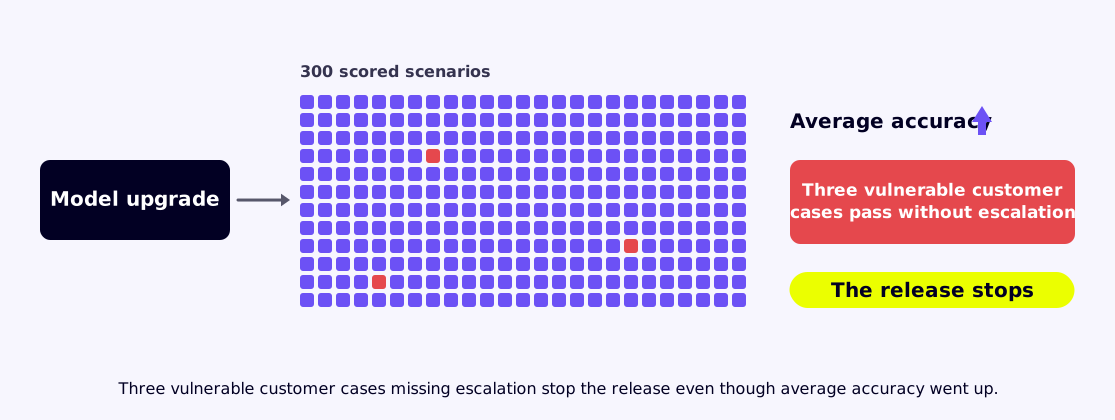
Agents need pre-release testing that scores their decisions against policy as well as their answers against facts. A test suite for a regulated agent holds edge cases, adversarial inputs and cases near every threshold. It runs again whenever the model, prompt, tools or boundary changes.
A lending team preparing a hardship agent might build 300 scored scenarios from past cases. Some sit just under the payment deferral limit and some just over. Others involve customers flagged as vulnerable, where the rules require a person to decide at any amount.
The release gate is what makes the suite matter. If a model upgrade lifts average accuracy but lets three vulnerable customer cases through without escalation, the release stops. Average scores hide the exact failures a regulator will ask about.
This costs time upfront. It also hands your model risk team something familiar, a validation pack with evidence, which shortens approval for the next agent.
Where governance programs usually stall with agentic systems
Governance programs stall when they copy the controls built for analytics and stop there. Data classification, access reviews and model inventories still matter. They just don't cover authority to act, and many firms haven't assigned an owner for agent decisions at all.
Human review is the weak spot that looks strong on paper. Reviewers are people, and a University of Melbourne global study found 66% of employees rely on AI output without evaluating its accuracy. Put that habit in an approval queue and a reviewer clearing 200 agent recommendations a day becomes a rubber stamp. The control exists in the policy document and nowhere else.
Lumenalta®'s specialist teams embed decision traceability and compliance controls in delivery. The practical fixes are plain. Size review queues so people can read each case, show reviewers the evidence the agent used and track overrides as a quality signal. If overrides fall to zero, check the reviewers as well as the agent.
Governance that lets agents earn more autonomy over time
Agents should earn autonomy the way new hires do, one action class at a time, on a record you can show an examiner. Start them at recommend, measure accuracy and escalation quality, then widen the boundary where the evidence supports it. Firms that work this way end up with more autonomy than the ones that rush.
Picture an agent that spends three months recommending low-value refunds with clean audits and few overrides. Moving it to act within limits is then a documented decision your risk committee can sign. The pace feels slow at the start, and it compounds, because each wider boundary is backed by evidence and the next conversation with your regulator gets shorter. Lumenalta® works in that order with clients in financial services and other regulated sectors, setting boundaries and escalation first, then audit, then wider autonomy as the record builds.
Table of contents
- What autonomous AI agents decide inside a regulated firm
- Why read access controls miss the risk agents carry
- How decision boundaries set the limits of agent autonomy
- Matching agent autonomy levels to the risk of each action
- Escalation paths that put a named person on every exception
- What an audit trail for agent decisions has to record
- Testing agent behavior before regulators or customers do
- Where governance programs usually stall with agentic systems
- Governance that lets agents earn more autonomy over time
Learn why agent autonomy without decision boundaries increases regulatory risk, remediation cost, and reporting delays.