


How to implement a data governance policy AI teams follow
NOV. 9, 2026
6 Min Read
A data governance policy only works when the platform enforces it where AI teams already work.
Most policies are written for auditors. They describe data owners, classification levels and retention periods in a document that delivery teams read once, if at all. Then a data scientist needs a training set by Friday, the approval path takes three weeks and the copy ends up on a laptop. The policy didn't fail because people ignored it. It failed because following it was slower than working around it.
The same pattern shows up on the culture side, where Gartner predicts that 60% of organizations that fail to address governance culture challenges will fail to govern AI successfully by 2027. You won't fix culture with a better document. You fix it when the governed path becomes the fastest path, so AI teams meet the policy by default.
Key Takeaways
- 1. Governance programs fail after delivery when the policy and the platform are built as separate projects with nothing connecting them.
- 2. Every clause of a data governance policy should map to a control the platform runs on its own, or be rewritten until it can.
- 3. AI teams follow governance when the compliant path is the fastest one, with access, quality checks and lineage handled inside their existing tools.
Why data governance programs fail after the platform is delivered
Governance programs fail after delivery because the policy and the platform were built as separate projects. The platform team ships storage, compute and pipelines. The governance team ships a policy document. Nothing connects the two, so the first deadline pushes teams into copies, extracts and shared credentials the policy never anticipated.
A familiar sequence plays out at a retailer that has just launched a new lakehouse. Within six months, analysts have created 200 personal schemas with customer data, half without a classification tag. The governance council meets monthly and reviews a spreadsheet of access requests. None of it reflects what's actually happening in the platform, so the council governs a picture that's already out of date.
What a data governance policy should include for AI work
A data governance policy for AI work should define who owns each data domain, how data is classified, who can access each class, what quality thresholds apply and how lineage is recorded. It should also cover what's new with AI, such as which data can train a model and which can be sent to an external model.
"It failed because following it was slower than working around it."
Keep the policy short enough that an engineer can map each clause to a control. These are the areas it needs to cover.
- Domain ownership, with a named owner for each data product
- Classification levels and the tags that mark them in the platform
- Access rules tied to roles and purposes, including model training
- Quality thresholds for each critical table and what happens on a breach
- Lineage and audit requirements for data used in AI outputs
A policy that says "sensitive data must be protected" can't be enforced. A policy that says "columns tagged PII are masked for every role except the owning team" can be turned into code the same afternoon.
How to turn written policy into platform controls
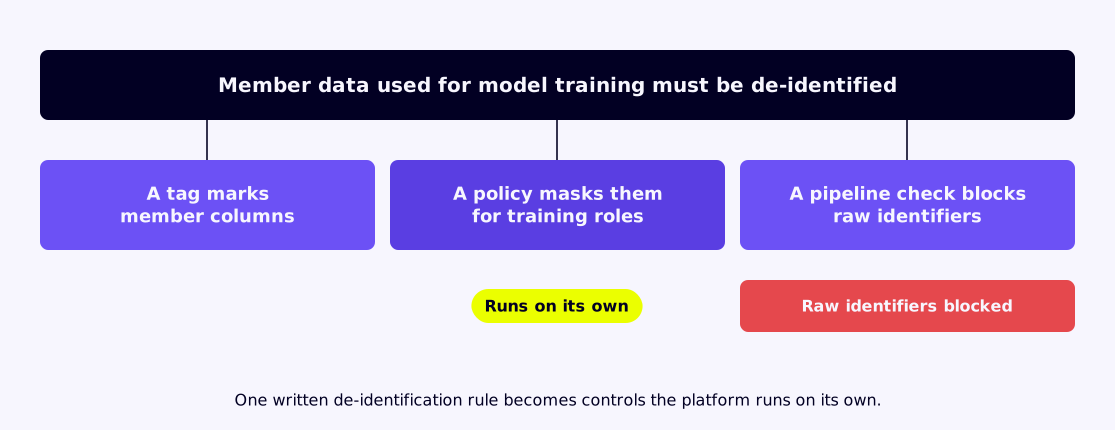
Turn written policy into platform controls by mapping every clause to a mechanism the platform runs on its own. Classification becomes tags, access rules become policies on those tags, quality thresholds become checks in the pipeline and lineage becomes metadata captured automatically. A clause with no matching control is a gap to close or remove.
Consider a health insurer's rule that member data used for model training must be de-identified. As a document, that rule depends on each data scientist remembering it. As a control, a tag marks member columns, a policy masks them for training roles and a pipeline check blocks any training table that still holds raw identifiers.
Agents need context too, because an agent without a shared business definition will guess. For governance, that context is the tags, owners and permissions an agent reads before it touches a table.
The mapping exercise also exposes clauses nobody can enforce. Those usually get rewritten, which makes the policy shorter and more honest.
How to implement data governance in stages across an enterprise
Implement data governance in stages, starting with the domains your AI use cases depend on most. Govern one domain fully, with owners, tags, access policies and quality checks, then repeat the pattern. Enterprise-wide rollouts that try to classify everything at once tend to stall before any team feels the benefit.
"The mapping exercise also exposes clauses nobody can enforce."
A bank planning an AI model for credit decisions might start with customer and account data, since both feed the model and both carry regulatory weight. Once that domain is tagged and monitored, the same templates apply to transaction and collateral data in weeks rather than months. Staging also gives the governance council something concrete to review. Instead of debating principles, it reviews which controls fired last month and which owners resolved them.
What data quality monitoring for AI should check
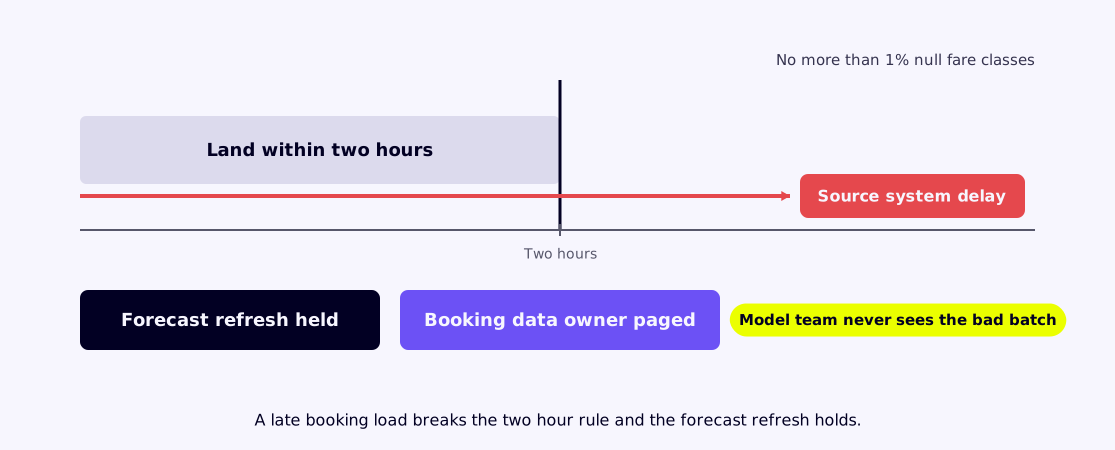
Data quality monitoring for AI should run on every load, check the thresholds the policy sets and alert the owner before bad data reaches a model. It tracks freshness, completeness, validity and drift for each critical table, and it records results, so teams can prove a model trained on data that met the standard.
An airline forecasting bookings might set a rule that booking data must land within two hours and contain no more than 1% null fare classes. When a source system delay breaks that rule, the pipeline holds the forecast refresh and pages the booking data owner. The model team never sees the bad batch.
Monitoring also changes the governance conversation. The council stops debating if data is good enough and starts looking at breach counts and time to resolution by owner. Those numbers point to where ownership is working and where it's only on paper.
How to enforce data governance automatically without slowing delivery
Enforce data governance automatically by placing controls inside the tools teams already use, so the compliant path is also the fastest one. Access is granted by policy instead of by ticket, quality checks run in the pipeline and lineage is captured as code runs. Teams follow the rules because there's nothing extra to do.
The payoff shows up in governance results. Organizations that deployed AI governance platforms are 3.4 times more likely to achieve high effectiveness in AI governance than those that didn't, according to a Gartner survey of 360 organizations.
Lumenalta®'s specialist teams build these controls into the data platform during delivery, with decision traceability and compliance controls embedded from the first sprint. A new data product ships with its owner, tags, access policy and quality checks already in place.
| Policy clause | Automated control that enforces it |
|---|---|
| Every data product has a named owner | Publishing a table fails unless an owner field is set in the catalog |
| Sensitive columns are protected | Classification tags trigger masking for every role outside the owning team |
| Training data is approved for model use | A purpose tag grants training roles access only to approved tables |
| Critical tables meet quality thresholds | Pipeline checks hold downstream jobs and alert the owner on a breach |
| AI outputs can be traced to sources | Lineage is captured automatically from every query and pipeline run |
Each row turns a sentence in the policy into a check that runs without anyone having to remember it. Start with the clauses that block the most AI work today, often ownership and training approval, and add the rest as each control proves it doesn't slow delivery. A policy enforced this way stays current because the control changes when the clause does.
Why enforced governance earns trust that documents never will
Enforced governance earns trust because people can see it working. A control that blocks a bad load or masks a column shows the policy is real. A document only describes intentions, and teams under deadline pressure treat it as optional, however carefully it was written.
The work is steady rather than dramatic. Owners get named, clauses get mapped to controls, breaches get resolved and the policy gets shorter each time a clause proves unenforceable. Over a year, that discipline produces a platform where AI teams can't easily break the rules, and rarely want to.
That's how Lumenalta® approaches governance work, turning policy into automated checks and monitoring that AI and analytics teams meet by default.
Table of contents
- Why data governance programs fail after the platform is delivered
- What a data governance policy should include for AI work
- How to turn written policy into platform controls
- How to implement data governance in stages across an enterprise
- What data quality monitoring for AI should check
- How to enforce data governance automatically without slowing delivery
- Why enforced governance earns trust that documents never will
See how an enforced data governance policy lowers cost and improves data agility.