


Mosaic AI for enterprise agent builds on Databricks
NOV. 6, 2026
6 Min Read
Mosaic AI gets enterprise agents into production faster because it builds them next to the governed data they depend on.
Most agent prototypes never make that trip. MIT's NANDA initiative found that about 95% of generative AI pilots delivered little to no measurable impact on profit and loss. The model is rarely the reason. The usual cause is the distance between the prototype and the data it needs, which teams fill with exports, copies and access exceptions that security won't approve for production.
Databricks Mosaic AI closes that distance. The agent, its tools, its evaluation data and its monitoring all sit on the same platform and under the same Unity Catalog permissions as the tables it reads. Permissions, lineage and evaluation come with the agent from day one. That's the practical case for building agents on the lakehouse, and it's strongest in regulated, data-heavy enterprises.
Key Takeaways
- 1. Databricks Mosaic AI shortens the path from agent prototype to production by keeping agents, tools and evaluation under the same governance as the data.
- 2. Agents built outside the lakehouse pay for flexibility at production time, when data copies, duplicate access rules and new security reviews pile up.
- 3. Model choice stays open on Mosaic AI because AI Gateway governs every provider, so evaluation scores can decide which model runs each agent.
What Databricks Mosaic AI does for enterprise agent builds
Mosaic AI is the set of Databricks capabilities for building, evaluating, serving and monitoring AI agents and models on the Data Intelligence Platform. It includes the Agent Framework for authoring agents, Agent Evaluation for scoring them, Vector Search for retrieval, Model Serving for deployment and AI Gateway for governing model traffic.
Each piece reads from Unity Catalog. An agent that answers questions about supplier contracts retrieves from a vector index built on governed documents. It calls SQL functions registered as tools and logs every trace through MLflow. Nothing moves to a separate stack, so the controls on the contract data also apply to the agent reading it.
Why governed data shortens the path from prototype to production
Agents stall between prototype and production when security, risk and data owners can't see what the agent reads or does. Building on governed data answers those questions upfront. Permissions, lineage and audit logs already exist for the tables, so the agent inherits controls that reviewers have approved before.
Through 2026, organizations will abandon 60% of AI projects unsupported by AI-ready data, Gartner predicts. Agents feel that risk first, because they act on data instead of only displaying it.
Databricks makes a related argument in its Agent Bricks update from June 2026, saying agents need the right context from enterprise data to make business-correct decisions. For a Mosaic AI build, that context means governed tables, documented metric definitions and tool functions with owners, all visible to the agent through the same catalog.
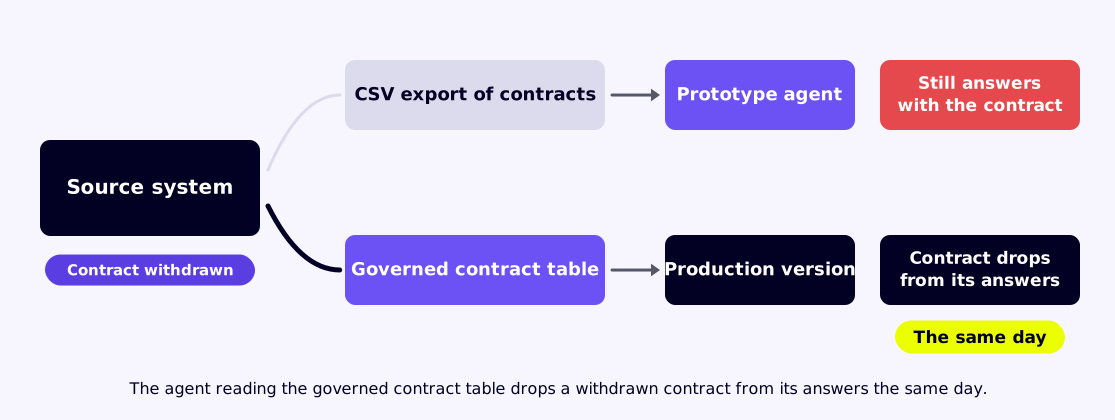
A procurement team shows the difference. Its prototype agent worked on a CSV export of contracts. The production version reads the governed contract table directly, so a contract withdrawn in the source system disappears from the agent's answers the same day.
How an agent moves through Mosaic AI from build to monitoring
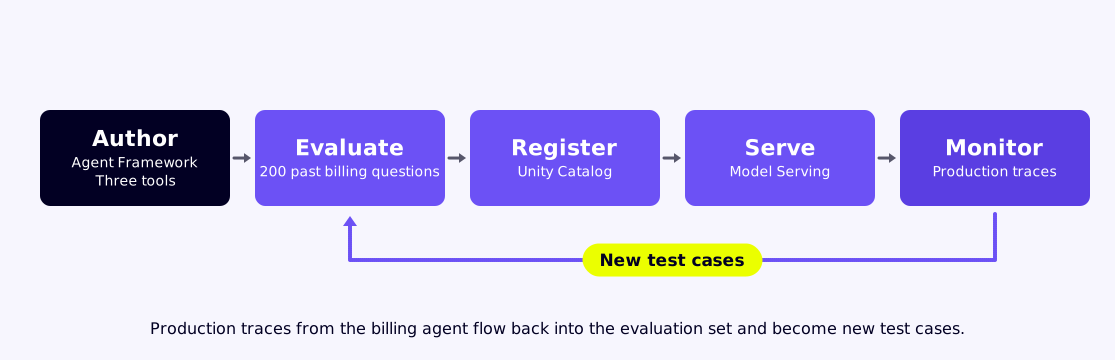
An agent on Mosaic AI moves through five stages, each on the same platform. You author it, evaluate it against scored examples, register it with its version, serve it behind an endpoint and monitor its traces in production. Every stage writes to MLflow, so you can trace any answer back to the build that produced it.
A customer service team building a billing agent can follow that path in a few weeks. Engineers write the agent with the Agent Framework and give it three tools for account lookups, invoice retrieval and payment status. Agent Evaluation scores it against 200 past billing questions with known answers. The team registers the version in Unity Catalog and serves it through Model Serving. Production traces then flow back into the evaluation set, so new failure patterns become test cases.
The loop is the part teams underrate. An agent that isn't re-evaluated after every prompt or model change drifts quietly, and nobody notices until a customer does.
Building agents on Mosaic AI versus outside the lakehouse
The main difference between building agents on Mosaic AI and building them outside the lakehouse is where governance lives. On Mosaic AI, the agent uses the same catalog, permissions and lineage as your data. Outside it, your team rebuilds those controls in another stack and keeps the two in sync.
External frameworks have real strengths, including flexible orchestration and fast prototyping. The cost appears at production time, when data copies need approval and access rules exist twice.
| Concern | Agents built on Mosaic AI | Agents built outside the lakehouse |
|---|---|---|
| Data access | The agent reads governed tables in place under existing permissions. | Data is exported or replicated, which adds copies that need their own controls. |
| Lineage | Answers trace back to source tables through the same catalog. | Lineage stops at the export unless your team builds a bridge. |
| Evaluation | Scored test sets and production traces share one store. | Evaluation tooling sits apart from the data it should test against. |
| Model choice | Several model providers run behind one governed gateway. | Each provider integration brings its own keys, logs and limits. |
| Security review | Reviewers assess one platform with controls they've approved before. | Reviewers assess a new stack and every connection into it. |
"An agent that isn't re-evaluated after every prompt or model change drifts quietly, and nobody notices until a customer does."
Use cases where Mosaic AI agents earn their place first
Mosaic AI agents pay off first where the answer depends on large volumes of governed enterprise data and errors carry a cost. Good first candidates combine structured and unstructured data, have a clear owner and come with past cases you can use for evaluation.
Five use cases tend to meet that bar early.
- Contract and policy question answering over governed document libraries
- Finance analysis agents that query certified tables and explain variances
- Customer service agents that read account, billing and case history
- Supply chain agents that compare supplier performance against contract terms
- Data engineering agents that document pipelines and flag quality issues
Each has data already in the lakehouse and a team that can judge the answers. Lumenalta®builds agents with Mosaic AI as a certified Databricks Delivery Partner (DPP), with teams of senior specialists and agents doing the engineering.
Choosing models for Mosaic AI agents without losing governance
Mosaic AI lets you choose the model per agent while keeping one governance layer. AI Gateway applies rate limits, usage logging and safety guardrails across hosted and external models, so swapping a model doesn't mean rebuilding controls. Choose on evaluation scores for the task, cost per request and the data rules that apply.
"A prototype on a laptop will always look faster in week one."
A legal operations agent might run on Claude because its long contracts reward careful reading and its answers need cited clauses. A high-volume triage agent on the same platform might use a smaller open model to keep cost per request low. Both run behind the same gateway with the same logging. The evaluation set decides, and it should be rerun whenever a provider ships a new version.
Treating agent builds as production systems from the start
The teams that get agents into production treat the first prototype as the first version of a production system. They build on governed data, write evaluation sets before demos and monitor from the first deployment. Mosaic AI makes that discipline cheaper, but it doesn't supply the discipline itself.
That's the honest tradeoff. A prototype on a laptop will always look faster in week one. Three months later, the agent built inside the platform is the one still running, because security approved it, evaluations caught its regressions and its answers trace back to source. Lumenalta® works with Databricks at our core and as an Anthropic Select Partner, connecting Mosaic AI agents to models such as Claude where the use case calls for it.
Table of contents
- What Databricks Mosaic AI does for enterprise agent builds
- Why governed data shortens the path from prototype to production
- How an agent moves through Mosaic AI from build to monitoring
- Building agents on Mosaic AI versus outside the lakehouse
- Use cases where Mosaic AI agents earn their place first
- Choosing models for Mosaic AI agents without losing governance
- Treating agent builds as production systems from the start
See how building agents on Mosaic AI improves AI accuracy and controls spend.