


What is a data lake? (updated 2026)
NOV. 9, 2026
6 Min Read
A data lake is a central store that keeps raw data in any format at low cost, and for most enterprises today it's the foundation a lakehouse is built on.
The definition hasn't changed much in a decade. What's changed is what you expect the data to do. Generative AI use among organizations reached 81% in Flexera's 2026 survey, up from 47% two years earlier, and those workloads need data that's governed, current and easy to find.
A lake on its own stores data well but struggles to serve it with that kind of reliability. Most teams will keep their lake. The practical question is when to add the table format, catalog and permissions that turn it into a lakehouse.
Key Takeaways
- 1. A data lake stores raw data of any type on low-cost object storage and applies structure only when the data is read.
- 2. A lakehouse keeps that storage and adds transactional tables, schema control and a catalog of owners, lineage and permissions, so one copy serves reporting and AI.
- 3. Move to a lakehouse when dashboards, warehouse copies or AI agents start depending on lake data, and convert the most-used data first.
What a data lake is and what it stores
A data lake is a repository that stores structured, semi-structured and unstructured data in its original form on low-cost object storage. Data lands first and gets a schema later, when someone reads it. That approach lets you keep everything without deciding upfront how it'll be used.
A retail bank's lake might hold daily transaction extracts as Parquet files, mobile app event logs as JSON, scanned loan documents as PDFs and call center recordings as audio. None of it needs a predefined table to land. A data engineer can load a new source in an afternoon instead of waiting on a modeling review.
That flexibility is why lakes spread so quickly. It's also why many turned into swamps, full of files nobody could find, trust or explain.
How a data lake differs from a data warehouse
The main difference between a data lake and a data warehouse is when structure gets applied. A warehouse requires a schema before data loads, which makes it fast and reliable for reporting. A lake accepts data as it arrives and applies structure when it's read, which makes it flexible and cheaper to scale.
A finance team closing the quarter works best from a warehouse, because every revenue figure has to match a defined model. A data science team training a churn model wants the lake, because it needs raw clickstream and support transcripts that no warehouse schema anticipated.
Many enterprises ran both and copied data between them. That kept two versions of key numbers, doubled storage and created pipelines that broke whenever a source changed.
Data lake use cases that still hold up for enterprises
Data lakes still suit workloads that need large volumes of raw or varied data at low cost. Machine learning training sets, long-term archives, log analytics and landing zones for new sources all fit the lake pattern. They share one trait, which is that data has value before anyone has modeled it.
A manufacturer collecting sensor readings from production lines is a good case. Each line sends readings every second, and most of that data is only reviewed when a fault occurs. Keeping it raw in a lake costs little, and engineers can replay months of history when they need to trace a defect. The same lake also stores the inputs for predictive maintenance models.
- Training data for machine learning models that need raw history
- Low-cost archives kept for audit or regulatory retention
- Log and telemetry analysis across applications and devices
- Landing zones that accept new sources before they're modeled
- Unstructured content such as documents, images and audio for AI
The benefits of a data lake and where they stop
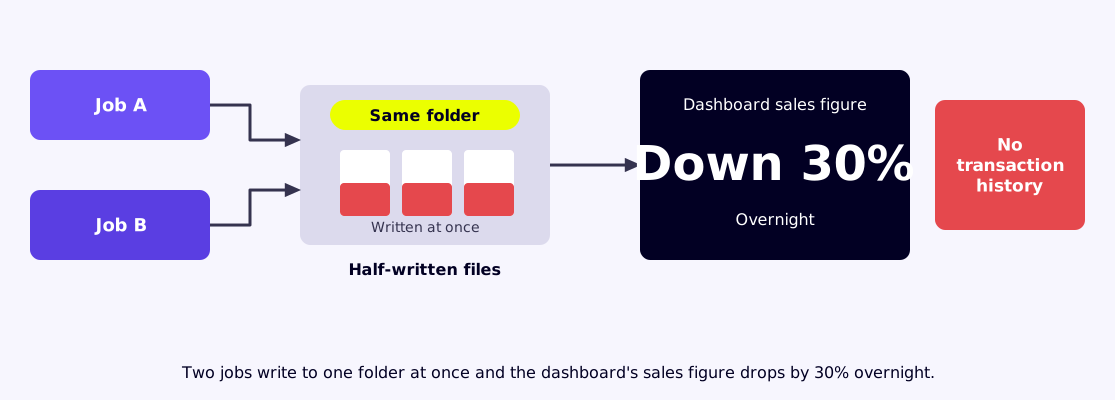
The benefits of a data lake are low storage cost, support for any data type and fast onboarding of new sources. Those benefits stop where reliability starts to matter. Plain files on object storage can't enforce schemas, roll back bad writes or apply fine-grained permissions on their own.
A common failure looks like this. Two jobs write to the same folder at once, a dashboard reads half-written files and a sales figure drops by 30% overnight. Nobody can tell which version was right, because the lake kept no transaction history.
Governance gaps cause the bigger problems. A 2024 Gartner survey of 1,203 data management leaders found 63% of organizations either lack the right data management practices for AI or aren't sure they have them.
In a plain lake, nothing tells an analyst or an AI agent who owns a file, how fresh it is or who's allowed to read it.
What a lakehouse adds on top of a data lake
A lakehouse adds a transactional table format and a governance layer on top of the lake's object storage. Data stays in open files you control, but you gain the schema enforcement, versioning and permissions a warehouse provides. One copy of the data then serves reporting, data science and AI.
"Nobody can tell which version was right, because the lake kept no transaction history."
On Databricks, Delta Lake tables give each write a transaction log, so failed jobs roll back and you can query yesterday's version of a table. Unity Catalog sits above them and records owners, tags, lineage and access rules across tables, files and models.
AI agents need governed business definitions as context before their answers can be trusted. For a lake, context means a catalog entry, an owner and a definition behind each table an agent can query.
| Capability | Data lake | Lakehouse |
|---|---|---|
| Storage cost | Low-cost object storage for every data type | The same object storage, with open table files on top |
| Reliability of writes | Concurrent jobs can leave partial or conflicting files | A transaction log makes each write complete or rolled back |
| Schema control | Structure is applied only when someone reads the data | Tables enforce a schema and can change it in a tracked way |
| Access and ownership | Folder permissions with little record of who owns what | A catalog tracks owners, tags, lineage and fine-grained access |
| Who it serves | Data engineers and data scientists working with raw files | Analysts, data scientists and AI agents from one copy of data |
When a company should move from a data lake to a lakehouse
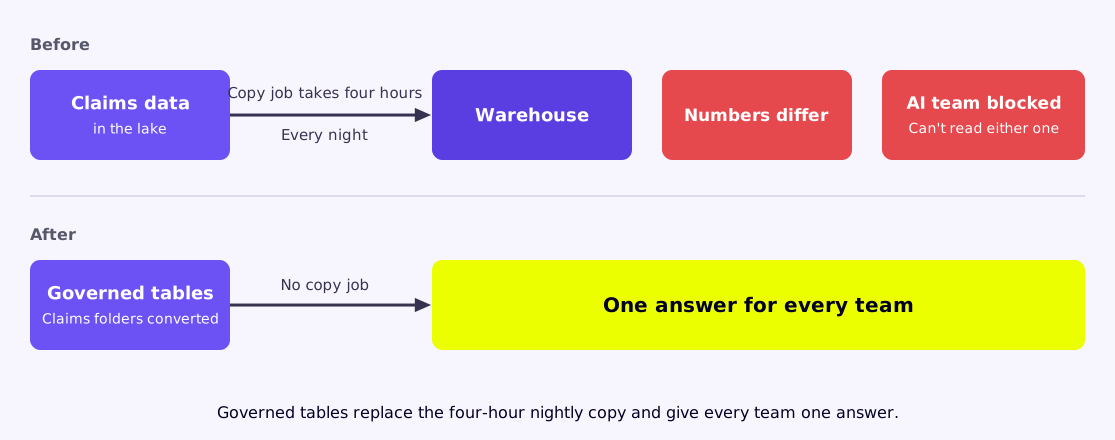
A company should move to a lakehouse when people or AI systems start depending on lake data for decisions. Recurring dashboards on lake files, copies into a separate warehouse and requests for agent access are the clearest signals. Each one means reliability and governance now carry business risk.
An insurer that copies claims data from its lake into a warehouse every night shows the pattern. The copy job takes four hours, numbers differ between the two systems and the AI team can't get permission to read either one. Converting the claims folders to governed tables removes the copy and gives every team one answer.
Lumenalta®, a certified Databricks Delivery Partner (DPP), handles this move by converting the most-used lake data to Delta tables first and registering it in Unity Catalog with owners and tags. The rest of the lake stays where it is until a use case needs it.
Getting value from the data you already keep
A data lake is still the right place to keep raw data cheaply. The value comes from deciding which parts of it deserve structure, ownership and access controls, then adding them on purpose. Teams that do this table by table get a lakehouse without a disruptive rebuild or a second copy of their data.
"Converting the claims folders to governed tables removes the copy and gives every team one answer."
That's a discipline more than a project. Start with the data your reports and models already read, give it owners and definitions, and let the rest wait. Lumenalta®'s specialist teams work this way on Databricks, with governance built in from the first table, so each step adds value you can measure.
Table of contents
- What a data lake is and what it stores
- How a data lake differs from a data warehouse
- Data lake use cases that still hold up for enterprises
- The benefits of a data lake and where they stop
- What a lakehouse adds on top of a data lake
- When a company should move from a data lake to a lakehouse
- Getting value from the data you already keep
Common questions about data lakes
What is a data lake, and how does it work?
How is a data lake different from a data warehouse?
What are the key components of a data lake?
What industries benefit the most from a data lake?
What are the biggest challenges of managing a data lake?
See how moving from a data lake to a lakehouse lowers cost and improves data agility.