

What is data modernization?
NOV. 16, 2026
6 Min Read
Data modernization is the work of making your data governed, defined and trusted enough for AI to use, and a platform move is only one part of it.
That definition has shifted since modernization meant retiring an on-premises warehouse. Sixty-three percent of organizations either lack the right data management practices for AI or aren't sure they have them, according to a Gartner survey. Many of those firms have already moved to the cloud. Their data sits on newer infrastructure and still can't support a model or an agent, because the definitions, ownership and quality checks never moved with it.
Once AI is the goal, a modernization program gets judged by a different test. The question stops being if the warehouse migrated on time. It becomes how fast the next AI use case can find data it understands, trust what it finds and prove where an answer came from.
Key Takeaways
- 1. Data modernization is the work of making data governed, defined and trusted enough for AI to use, and a cloud migration is only one step inside it.
- 2. AI-ready data needs shared definitions, named owners, lineage, quality checks and access policies that apply to people, models and agents alike.
- 3. Sequencing modernization by use case delivers AI value each quarter and leaves governed data products the next use case can reuse.
What data modernization means when AI is the goal
Data modernization means rebuilding how data is stored, defined, governed and served so that analytics, models and agents can all use it without rework. With AI as the goal, the finish line moves. It sits at the point where a new use case can start on trusted data in weeks, well past the day the old system shuts down.
Take a retailer that wants a sales forecasting model and a merchandising assistant. Both need product, store and sales data. If each team rebuilds those tables its own way, the company pays twice and gets two versions of revenue. A modernized estate holds one governed product table, one definition of a sale and one owner for each.
That's why modernization now reads as a data product effort as much as an engineering one. The platform matters, and so does the meaning attached to what it holds.
Why moving to the cloud leaves AI readiness unsolved
A cloud migration changes where data lives and how it scales. It doesn't fix duplicate definitions, missing owners or undocumented pipelines. Lift-and-shift projects copy those problems onto a faster platform, where models and agents then find them at scale and repeat them in every answer.
Picture a bank that moved its customer data to cloud storage two years ago. Three tables still describe an active customer, each with different rules. An AI assistant asked how many active customers the bank serves will pick one, and nobody can say which. The migration finished on schedule, and the AI project inherits a question the migration never had to answer.
Data modernization versus cloud migration
The main difference between data modernization and cloud migration is scope. Cloud migration moves systems and workloads to new infrastructure. Data modernization changes how data is modeled, governed, owned and served, so the business and its AI can rely on it. A migration can be one step inside modernization, and it can't replace it.
"The migration finished on schedule, and the AI project inherits a question the migration never had to answer."
Budget pressure often decides which one a firm funds. The federal government shows the cost of waiting, with agencies typically spending about 80% of IT budgets on operating and maintaining existing systems. Money tied up keeping old platforms alive isn't available for the data work that AI needs.
| Question | Cloud migration | Data modernization |
|---|---|---|
| What changes | The infrastructure that stores and runs your data moves to a new platform. | The way data is modeled, owned and governed changes along with the platform. |
| How success is measured | Workloads run on the new platform and the old one is retired. | New analytics and AI use cases start on trusted data without rework. |
| Who owns it | Infrastructure and platform teams usually lead the effort. | Data, platform and business owners share the work and the definitions. |
| What it does for AI | Models get faster access to the same data with the same gaps. | Models and agents get governed data with clear meaning and lineage. |
| When it ends | The project closes once the cutover is complete. | The program keeps running as each new use case adds governed data. |
What AI-ready data needs beyond new infrastructure
AI-ready data needs meaning, ownership and proof on top of storage and compute. A model or agent can only use data correctly when it knows what a field means, who stands behind it, how fresh it is and who's allowed to see it. Those properties are designed into the estate, and they don't come free with a new platform.
Five properties separate AI-ready data from data that has simply moved.
- Shared business definitions for core metrics such as revenue and active customers
- A named owner for every dataset that AI systems read
- Lineage that traces each table back to its source systems
- Quality checks that run on every load and block bad data
- Access policies that apply equally to people, models and agents
Definitions tend to be the weakest of the five. Databricks makes the case in its argument for semantics in the data layer, noting that metric definitions belong next to the data, because agents spread fragmented definitions at scale. For a modernization program, that means writing metric views for revenue, margin and churn once, then pointing dashboards, models and agents at the same ones.
Insurers feel this quickly. A claims model that reads a different loss ratio than the finance team's report will be right by its own logic and wrong in the boardroom.
How to sequence a data modernization strategy around use cases
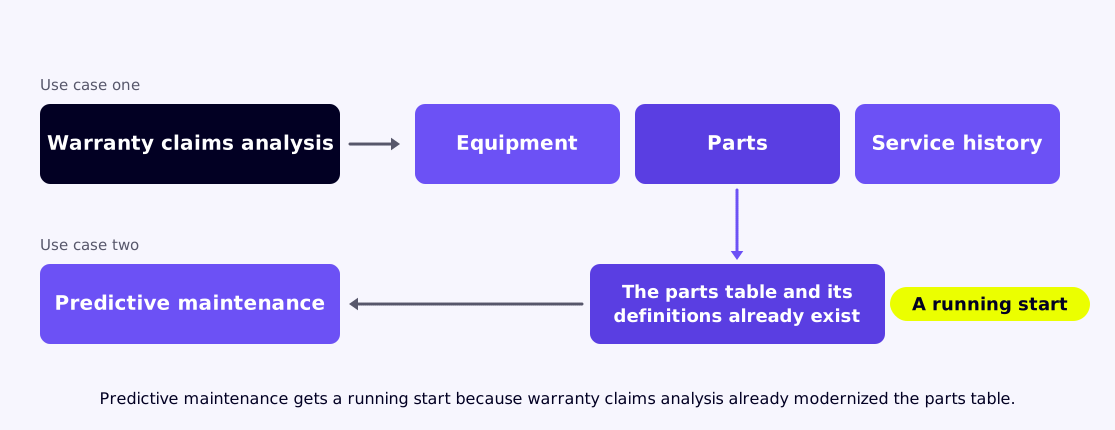
A data modernization strategy works best when you sequence it by the AI and analytics use cases that pay for it, rather than by system or by table. Pick two or three high-value use cases, modernize the data they depend on and let each one leave behind governed assets the next can reuse.
A manufacturer might start with warranty claims analysis and predictive maintenance. Both need equipment, parts and service history. Modernizing those domains first gives the second use case a running start, since the parts table and its definitions already exist. A broad migration of every plant system would take longer and deliver nothing usable until it ended.
The tradeoff is that legacy systems outside the first domains stay in place for a while. That's a reasonable cost. Running two platforms for a few quarters is cheaper than a program that spends a year migrating before any use case benefits.
Sequencing also keeps the program honest. Every quarter should end with a use case in production and a list of reusable data products it created.
How long data modernization takes and what shortens it
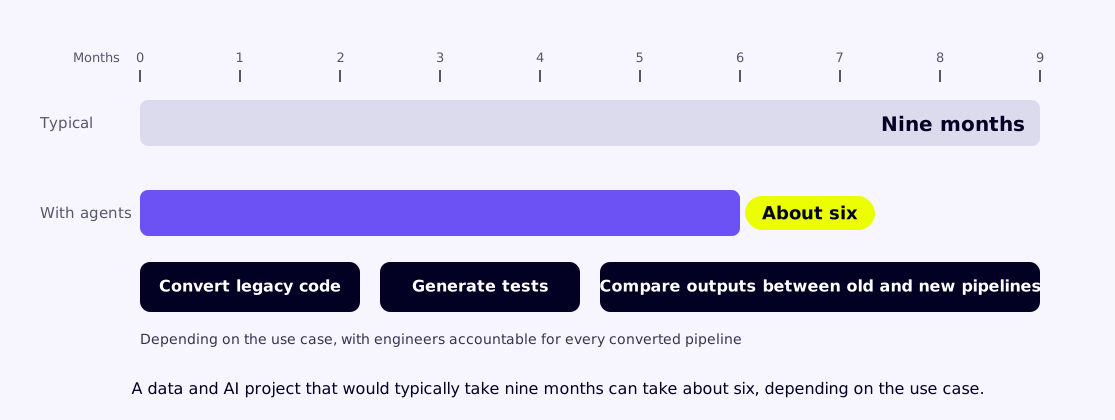
Data modernization rarely finishes, because new use cases keep adding governed data, but each phase should show results within months. A first domain with one or two use cases in production commonly takes two to three quarters. Code conversion, testing and validation usually consume most of that time.
"Running two platforms for a few quarters is cheaper than a program that spends a year migrating before any use case benefits."
Agents now shorten the slowest parts. Lumenalta®'s teams of senior specialists and agents work with AtlusAI, the delivery operating system we built for ourselves. Agents convert legacy code, generate tests and compare outputs between old and new pipelines. A data and AI project that would typically take nine months can take about six with us, depending on the use case. Engineers stay accountable for every converted pipeline, and the agents take on the repetitive checking that used to stretch timelines.
Speed only counts if quality holds. Faster conversion with weaker validation just moves defects into production sooner.
Judging data modernization by the AI work it supports
The fairest test of data modernization is how quickly and safely the next AI use case reaches production. If new models and agents can start on governed, defined data without a fresh cleanup project, the program has worked. If every use case still opens with months of data wrangling, it hasn't, wherever the data now lives.
That test favors steady, use-case-led work over big-bang programs. Each phase adds definitions, owners and lineage that the following phase inherits, and the gains compound. Lumenalta® works this way with Databricks at our core, delivering modernization one domain at a time so clients can see AI value arrive with each step.
Table of contents
- What data modernization means when AI is the goal
- Why moving to the cloud leaves AI readiness unsolved
- Data modernization versus cloud migration
- What AI-ready data needs beyond new infrastructure
- How to sequence a data modernization strategy around use cases
- How long data modernization takes and what shortens it
- Judging data modernization by the AI work it supports
Common questions about data modernization
What is data modernization, and why is it important?
How does data modernization differ from digital transformation?
What are examples of data modernization services?
What challenges do businesses face in data modernization?
How can a data modernization strategy benefit the insurance industry?
See how data modernization lowers cost and improves data agility.