


What is responsible AI?
NOV. 11, 2026
6 Min Read
Responsible AI is the practice of designing, building and running AI systems so they're fair, transparent, secure and accountable, with a control behind every principle.
Most enterprises already agree on the principles. What they lack is proof that the principles hold once a model or agent is in production. That gap is showing up in the numbers, with reported AI incidents reaching a record 362 in 2025, according to Stanford's 2026 AI Index.
The organizations that close the gap treat responsible AI as engineering work. Each principle maps to a control a team runs, tests and can show to an auditor.
Key Takeaways
- 1. Responsible AI rests on fairness, transparency, accountability, privacy and security, reliability and human oversight, and each needs its own test for each system.
- 2. A principle counts once it maps to a control with an owner, a test and a record, built into the release pipeline instead of run by hand before audits.
- 3. In regulated industries one logged control set answers model risk, fair lending and privacy rules, so a new regulation adds a test instead of a new program.
What responsible AI means for an enterprise today
For an enterprise, responsible AI means every AI system has a named owner, documented data sources, tested behavior and controls that match its risk. It covers predictive models, generative AI and agents that act on your behalf. The definition is the same as it was, but the expectation now is evidence.
A bank using a model to flag suspicious transactions shows the shift. A few years ago, a policy statement on fairness and a model validation report might have satisfied the review. Today the risk team also asks which data the model was trained on, who approved its release, how its alerts are monitored for drift and what happens when an analyst overrides it.
Agents raise the bar again. When a system can draft a customer reply or update a record, responsible AI has to cover what it's allowed to do as well as what it predicts.
The core principles behind responsible AI
The core principles of responsible AI are fairness, transparency, accountability, privacy and security, reliability and human oversight. Frameworks from NIST, the OECD and most large enterprises use close variants of this list. The principles overlap, so the useful work is defining what each one requires for a specific system.
A hiring screen and a fraud model share the same principles but need different tests. Fairness for the hiring screen means comparing outcomes across protected groups. Fairness for the fraud model means checking that false positives don't cluster in particular postal codes or customer segments.
Principles also pull against each other. A more explainable model can be less accurate, and tighter privacy controls can leave a fairness test without the demographic data it needs. Those tradeoffs are decisions, and someone with authority should make them and record why.
Generative AI and agents add reliability questions the older frameworks treated lightly. A chatbot that invents a policy or an agent that calls the wrong tool fails the reliability principle even when its training data was fair.
Turning each principle into a control your teams run
A principle becomes real when it maps to a specific control with an owner, a test and a record. Fairness becomes a bias test in the release pipeline. Transparency becomes a model card and lineage. Accountability becomes a named approver for every deployment, recorded where auditors can find it.
| Principle | Control that puts it into practice |
|---|---|
| Fairness | Outcome tests across relevant groups run before every release and on a monthly schedule after |
| Transparency | A model card and data lineage record what the system uses and how it reaches a result |
| Accountability | A named owner approves each release, and the approval is logged with the version it covers |
| Privacy and security | Access controls and masking limit what data a model or agent can read and return |
| Reliability | Evaluation sets and drift monitoring catch quality drops before users report them |
| Human oversight | Defined checkpoints require a person to approve high-impact actions an agent proposes |
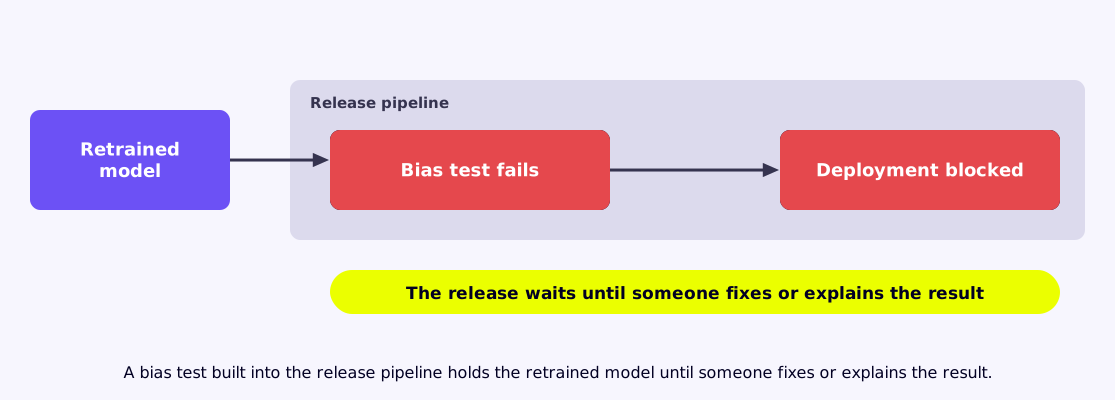
The controls only work if they're part of delivery. A bias test that someone runs by hand before an audit won't catch the retrained model that shipped last Tuesday. Built into the release pipeline, the same test blocks the deployment until someone fixes or explains the result.
Governance of the data underneath matters as much as the model. An agent without shared business definitions and permissions will guess or reach data it shouldn't. For responsible AI, that context means owners, tags and access rules on the data an agent reads, so privacy and accountability are enforced before a prompt ever runs.
How regulation shapes responsible AI in financial services
Financial services firms apply responsible AI under rules that already exist, including model risk management guidance, fair lending law and privacy regulation. New AI-specific rules such as the EU AI Act add documentation, risk classification and human oversight duties. The common thread is that firms must show evidence, and a policy statement on its own won't satisfy an examiner.
"A bias test that someone runs by hand before an audit won't catch the retrained model that shipped last Tuesday."
Consider a lender using a model to support credit decisions. Model risk guidance expects independent validation and ongoing monitoring. Fair lending rules expect the lender to explain adverse decisions to applicants. Privacy rules limit which data the model can use. One control set, run and recorded in delivery, answers all three.
That's why the mapping work pays off most in regulated industries. A firm that has already tied each principle to a logged control can respond to a new rule by adding a test instead of starting a new program.
Where responsible AI programs break down in delivery
Responsible AI programs break down when principles live in a policy document and delivery teams never see them. Reviews happen once at approval, controls run by hand and nobody owns monitoring after launch. The gaps appear months later, when a model drifts or an agent takes an action nobody tested.
Trust is the cost. Half of US adults say they're more concerned than excited about the increased use of AI in daily life, up from 37% in 2021, Pew Research Center found. Customers who already doubt AI won't give a second chance after a visible failure.
Several warning signs show a program is drifting from practice.
- Principles are published, but no control is mapped to any of them
- Reviews happen at approval and never again after launch
- Nobody can name the owner of a production model or agent
- Bias and quality tests run by hand ahead of audits
- Agents can take actions no one has listed or tested
How to implement responsible AI across the AI lifecycle
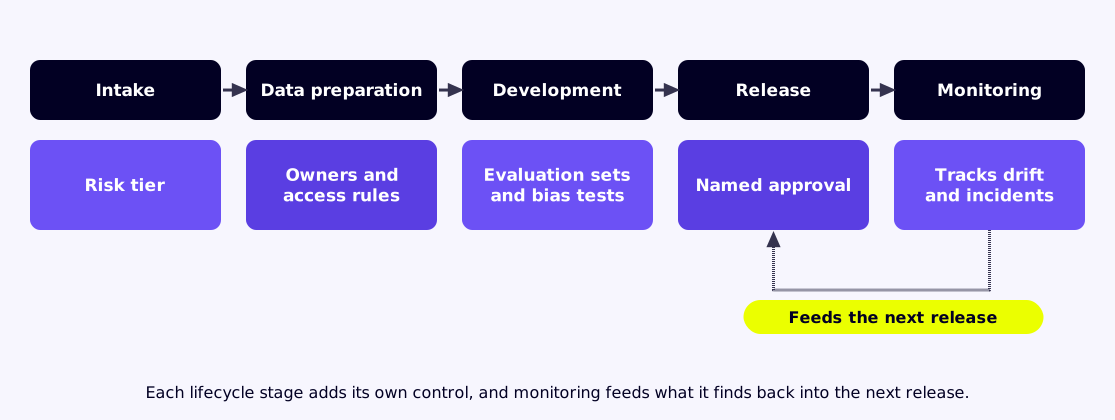
Implementing responsible AI means building controls into each stage of the lifecycle, from use-case intake through data preparation, development, release and monitoring. Each stage gets its own checks and owner. The aim is a system where skipping a control is harder than running it.
At intake, each use case gets a risk tier that sets how many controls apply. During data preparation, owners and access rules are set in the catalog. Development adds evaluation sets and bias tests, and release adds the named approval. Monitoring tracks drift, overrides and incidents, and it feeds what it finds back into the next release. Lumenalta®embeds decision traceability and compliance controls in delivery, so each principle maps to a delivery practice its specialist teams run on every engagement.
Responsible AI is proven in how you build
Responsible AI is proven by what your teams do every week. Principles set the direction, but controls, owners and records are what show a system is fair, safe and accountable. Organizations that build those into delivery spend less time preparing for audits and more time shipping AI people trust.
"The aim is a system where skipping a control is harder than running it."
The work compounds. Each control you automate protects every future release, and each incident you trace improves the next test. Lumenalta®'s teams of senior specialists and agents work this way shoulder to shoulder with client teams, with governance built in from the first use case.
Table of contents
- What responsible AI means for an enterprise today
- The core principles behind responsible AI
- Turning each principle into a control your teams run
- How regulation shapes responsible AI in financial services
- Where responsible AI programs break down in delivery
- How to implement responsible AI across the AI lifecycle
- Responsible AI is proven in how you build
Common questions about responsible AI
What is responsible AI, and why is it important?
How does responsible AI differ from traditional AI?
What are the core principles of responsible AI?
What are some use cases of responsible AI across industries?
How can businesses implement a responsible AI framework effectively?
See how responsible AI built into delivery improves AI accuracy and controls spend.