


Why enterprise AI adoption stalls at the data layer
NOV. 10, 2026
6 Min Read
Enterprise AI adoption stalls at the data layer, where fragmented and ungoverned data blocks use cases long before skills or budget run out.
Large companies have bought licenses, hired data scientists and run pilots, yet production use remains thin. Only 37% of firms with 250 or more employees reported using AI in the US Census Bureau's latest business survey. Those are the companies with the most money and the most specialists, so the gap points somewhere else.
It points at the data. When customer records live in four systems with four definitions, no model can produce an answer finance will sign off on. You can't train your way past that, and you can't spend your way past it either. The programs that scale fix the data first and keep one team accountable from the table to the use case.
Key Takeaways
- 1. Enterprise AI adoption usually stalls when a working pilot meets production data with conflicting definitions, missing owners and unclear access rules.
- 2. Skills and budget gaps are often symptoms, because specialists spend their time reconciling data instead of shipping use cases.
- 3. One team accountable for both the data platform and the use case removes the handoff where adoption breaks and makes each release cheaper.
What actually slows enterprise AI adoption in large companies
Enterprise AI adoption slows when a working pilot meets production data. The pilot ran on a clean extract, while production needs live, governed data from several systems. Teams then discover conflicting definitions, missing owners and unclear access rules, and the use case waits while those get settled.
Consider a retailer that built a sales forecasting pilot on one region's sales file. Accuracy looked strong. Scaling it meant joining store, e-commerce and promotion data, each owned by a different team with its own product codes. Six months later, the model was unchanged and the data work was still in progress. The forecasting team had the skills. What it lacked was an agreed product code and an owner who could approve the join.
Why skills and budget surveys point at the wrong cause
Skills and budget surveys point at the wrong cause because they ask about symptoms. Leaders see a stalled project and report missing talent or funds. The question behind it is usually why the talent spent months reconciling data instead of shipping, and what the budget bought.
A bank hiring ten more data scientists illustrates the trap. Each new hire spends the first quarter finding which customer table is correct and asking for access. Output barely moves, and the next survey reports a skills gap again.
The budget story runs the same way. Money goes to models and tools because those are visible line items. Data ownership, definitions and access rules have no vendor and no launch date, so they rarely get funded on their own.
That doesn't mean skills and budget are irrelevant. They matter, but they compound only once the data layer stops absorbing them.
How fragmented data breaks AI use cases after the pilot
Fragmented data breaks AI use cases because models and agents treat every table as true. When two systems define revenue differently, the model picks one and reports it confidently. Business users catch the mismatch, trust drops and the use case loses its sponsor long before anyone checks the model.
"Data ownership, definitions and access rules have no vendor and no launch date, so they rarely get funded on their own."
With agents, fragmented definitions spread at scale. For adoption, context means one approved definition of revenue, customer and margin that every model and dashboard reads.
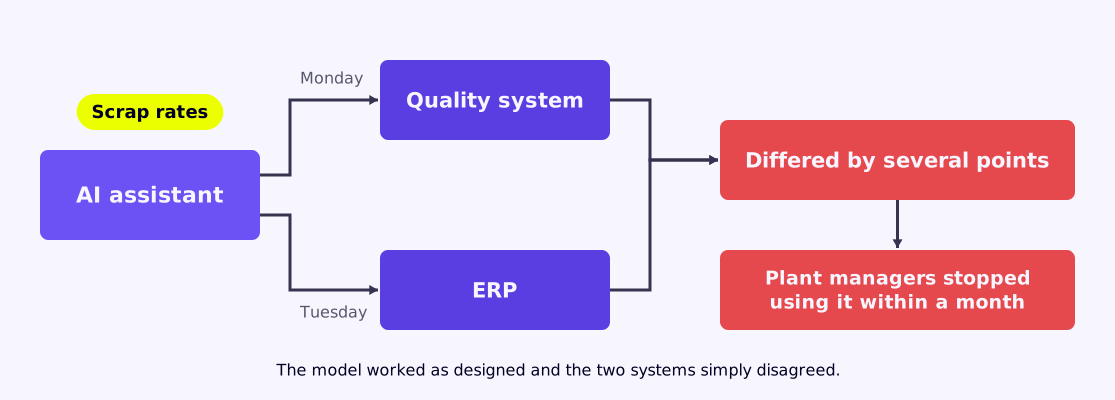
A manufacturer saw this with an AI assistant for plant managers. Asked for scrap rates, it pulled from the quality system on Monday and from the ERP on Tuesday, and the figures differed by several points. Plant managers stopped using it within a month. The model worked as designed. The two systems simply disagreed, and nobody owned the definition that would settle it.
The handoff between data teams and AI teams
Adoption usually breaks at the handoff between the team that owns the data platform and the team that builds the AI use case. Each team meets its own goals, yet nobody owns the result. Requests queue, priorities clash and the use case stalls between two backlogs.
"The model worked as designed. The two systems simply disagreed, and nobody owned the definition that would settle it."
Here's how that handoff typically compares with a single accountable team.
| Where adoption breaks | With a handoff between two teams | With one accountable team |
|---|---|---|
| Getting access to data | The AI team files a ticket and waits for the platform queue | The same team grants access as part of the use case plan |
| Fixing a bad definition | Each side assumes the other will correct it | The owner fixes it at the source and every consumer benefits |
| Moving from pilot to production | The pilot is rebuilt on production data by a different group | The pilot was built on governed data from the start |
| Answering an audit question | Lineage stops at the team boundary | Lineage runs from the source table to the model output |
| Reporting the business result | Nobody owns the number, so it rarely gets reported | One leader reports the result every quarter |
The table shows why the specialists need one shared goal and one person accountable for the outcome.
What a data platform ready for AI adoption looks like
A data platform ready for AI adoption has owners for each important table, shared business definitions, access rules a model can inherit and lineage from source to output. It doesn't need every table cleaned first. It needs the tables behind the next three use cases governed well.
Few companies are there yet. Some 63% of organizations either do not have or are unsure they have the right data management practices for AI, according to a 2024 Gartner survey of data management leaders. Narrow scope is the fastest way out. A healthcare provider might govern patient scheduling data first, ship a scheduling assistant on it and then extend the same rules to billing data. The provider doesn't wait for a perfect platform. It governs the data behind its next use case and moves on.
How to speed up AI adoption across business units
Speed up AI adoption across business units by reusing what the first use case governed. Each new unit should start from approved definitions, existing access rules and a tested delivery path. Adoption then accelerates because every release makes the next one cheaper.
Five practices make that reuse real.
- Publish shared definitions for core entities such as customer, product and revenue
- Assign a named owner to every table a production model reads
- Build new use cases on governed tables, never on one-off extracts
- Keep one delivery template so the second unit skips the setup work
- Report each use case's business result to the executive sponsor every quarter
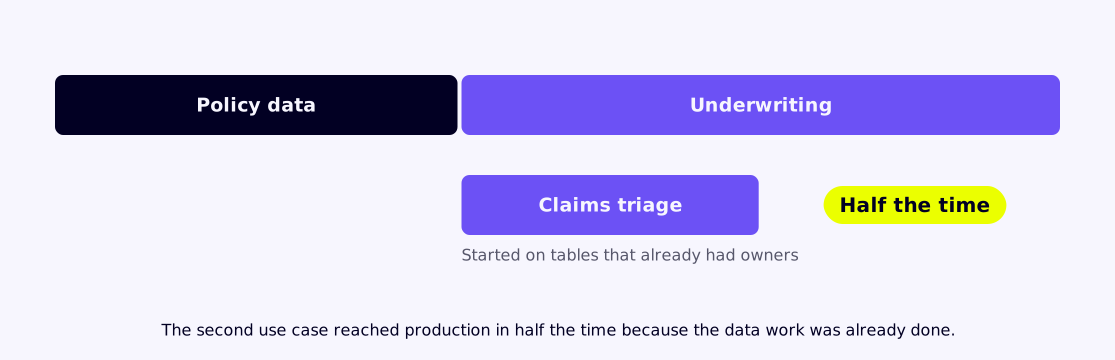
An insurer that governed policy data for underwriting reused the same tables for claims triage. The second use case reached production in half the time, because the data work was already done. The claims team didn't renegotiate access or rebuild definitions. It started on tables that already had owners.
Why one accountable team changes the adoption curve
One accountable team changes the adoption curve because it removes the handoff where most programs stall. When the same team owns the data platform and the use case, data fixes happen inside the delivery plan. Each release leaves the foundation stronger for the next one.
Lumenalta® works this way, with teams of senior specialists and agents owning the governed data and the AI use case as one piece of work. Governance is built into delivery, so decision traceability and compliance controls are in place before the first release.
None of this is glamorous. It's ownership, definitions and access rules, repeated with discipline. That repetition is what turns a stalled pilot into adoption you can measure. Judge it by how fast the second and third use cases ship.
Table of contents
- What actually slows enterprise AI adoption in large companies
- Why skills and budget surveys point at the wrong cause
- How fragmented data breaks AI use cases after the pilot
- The handoff between data teams and AI teams
- What a data platform ready for AI adoption looks like
- How to speed up AI adoption across business units
- Why one accountable team changes the adoption curve
Learn why fragmented, ungoverned data delays ROI and wastes budget.